
Creating an app is awesome, whether you do it yourself or exclusively with the help of prompt (vibe-coding).
We all love to create, myself included.
Before I help you “easily” market your apps, even if you know nothing about marketing, let me introduce myself.
My name is @bunbeau, and I made my first money on the internet back in 2001. That was the same year Wikipedia was launched, so:
– Yes, I’m a web dinosaur 🦖
– No, I’m not overwhelmed by technological advances…
…because it’s my passion, along with marketing 🙂
I’ve been a developer, but above all an entrepreneur, and I’ve lost count of the number of projects I’ve worked on. There have been many failures, a few successes, but also some epic fails (an HR tech startup with over 130,000 users). I’ve had the chance to work with dozens of entrepreneurs, from brick-and-mortar businesses to SaaS, etc. And despite my autistic traits, I excel at sales, product, and marketing (and I’m mediocre in many other areas, like everyone else).
In short, that means I talk nonsense, but not that much.
Let’s get back to your apps.
Whether it’s your first or your hundredth, the key to business is distribution.
Even if Apple had designed a great phone, if it hadn’t been excellent at distribution, we’d all still have crappy flip phones with Snake as the only game on them.
Distribution > everything else.
I’m not going to hold your hand here, but I will give you four key areas to focus on for your marketing. My ultimate recommendation: pick just one and go all out with it.
That’s the best way to learn and avoid spreading yourself too thin. There are no wrong paths, only bad marketers.
Five rules to remember, no matter which channel you decide to focus on:
1. Good things take time. Whether it’s ASO, ADS, UGC, etc., it takes time to get results and iterate. There are always exceptions, but overall, time is not your enemy, quite the contrary.
2. Your competitors are not your enemies, they are your allies, your colleagues. They are a valuable source of information, and if you don’t act like a jerk, they can even become friends (true story, a former competitor became my best man and a long-time friend, poke @joachim_terrier).
3. You need to know your target audience better than their parents and better than Google. That’s the key to marketing. For example, years ago, I helped entrepreneurs who were selling a niche service to oyster farmers. By studying the target audience, I realized that many of them loved… sports cars (and they had the budget for them, without being rich). So we started to have a physical presence at luxury dealerships… and business exploded 🙂
4. What gets measured improves. If you don’t measure what you’re doing, you won’t understand what works and what doesn’t. There’s nothing worse in marketing than moving forward blindly. You need to become so hungry for data that you check your stats before you go to the bathroom when you wake up in the morning. But be careful, you can’t interpret data when you don’t have enough of it… that would be risky and counterproductive.
5. The human brain evolves slowly. So study human psychology (even if it bores you). Technology is advancing at breakneck speed, but psychological biases have remained the same for centuries (except for declining attention spans).
Now that the rules are clear and you’ve probably tattooed them on your body Prison Break style, here are the four main ways to promote your app(s) that don’t require you to be a genius.
—
UGC
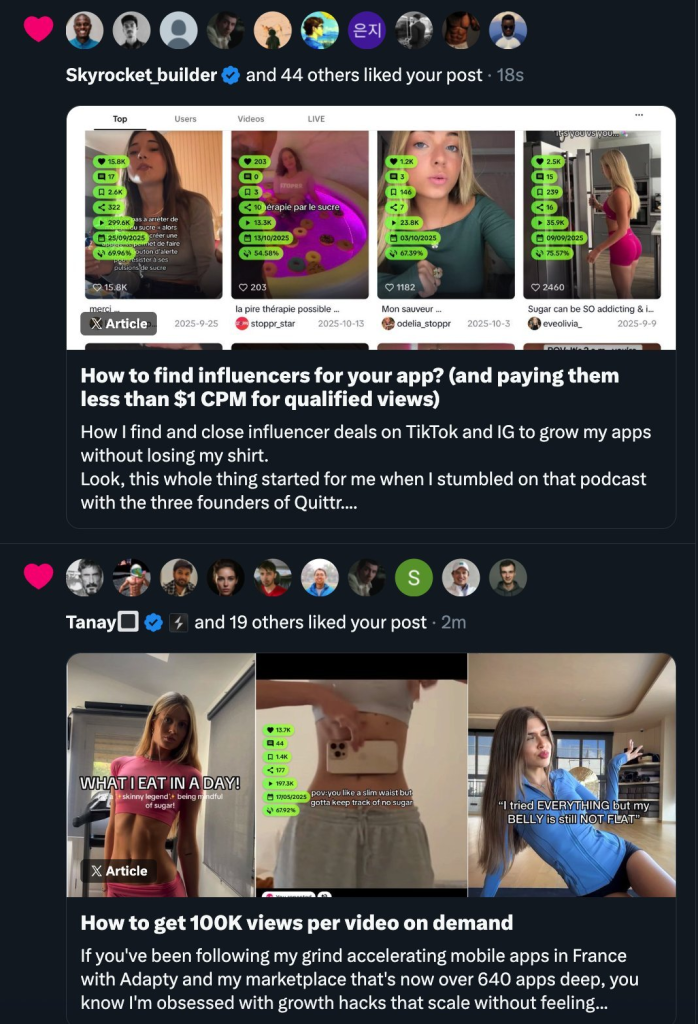
Guys like David Attias (@david_attisaas) will explain this better than I can, but the idea is simple (the execution is more complex): Create and distribute user-generated content. The huge advantage is that people always trust a recommendation from a user more than one from a salesperson. The other advantage is that today, platforms such as TikTok, YouTube Shorts, Instagram, etc. are hungry for quality content. So if you do things right (hook, retention, engagement, CTA), then you can reach thousands, even hundreds of thousands of relatively qualified people who are ready to download your app.
—
ASO
This is derived from SEO (search engine optimization), but for apps. In other words: when Sofia, a Bulgarian whose family immigrated to Austin, Texas, three generations ago, and mother of four rambunctious children, types “children’s park near me” into the App Store… what apps will Apple suggest to her? It’s important to understand that Apple (and to a lesser extent Google) will suck you dry like a junior vampire on each of your sales.
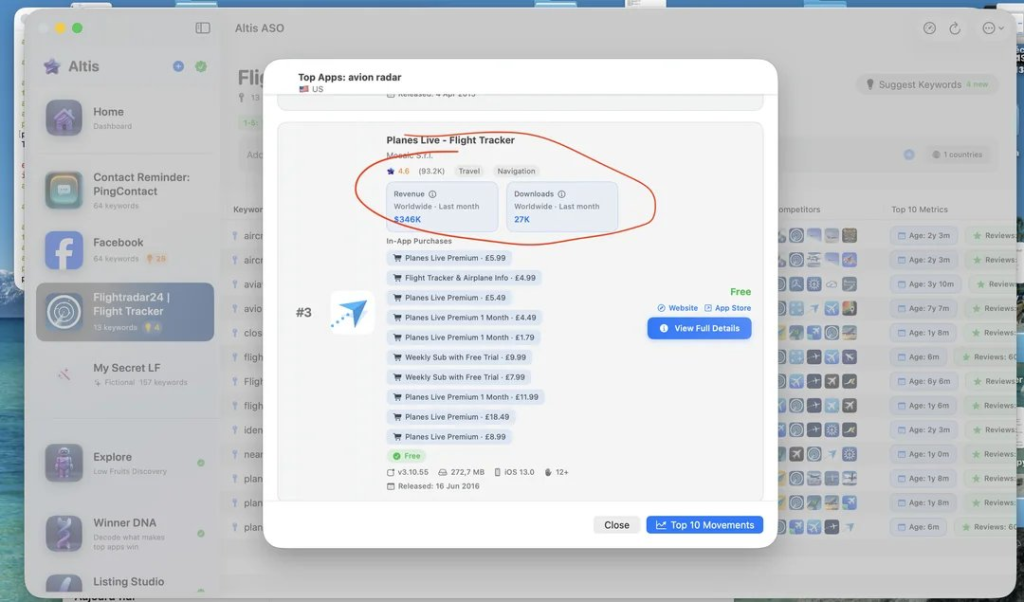
So it’s in their best interest to show Sofia the right apps as quickly as possible. Analyze the results, and try something else next time if there’s nothing to gain… So it has the same goal as you. Thanks to ASO, you can better position your app so that it is more visible to Sofia and others who are searching for keywords related to your app. I’ll take this opportunity to mention that I’m the founder of Altis ASO a native native Mac tool for ASO with a generous free plan that helps you spy on the competition, find interesting keywords, and track your positions in the stores. Install it now). ASO is a long-term game, but it’s a very profitable one.
—
ADS
Right now, there are people like Mario Saputra (@mariosaputra) and Max (@maks6361) who are experimenting with ads for their apps and publicly sharing their successes and failures. There are others, of course. Viktor Seraleev (@seraleev), for example, whose career I really admire, is good at advertising for his photo / video editing apps.
Having managed 6-figure sums in advertising across a fucking wide range of different businesses, I’m also going to give my humble opinion and a few quick tips:
1. A/B testing in ads is essential, if you don’t try multiple angles, you’ll lose money. You have to iterate and create variants of each ad that has a positive ROAS (return on ad spend) to optimize it.
2. You need a starting budget and goals, and you have to stick to them, just like at a casino. It often takes time for algorithms to understand what works and what doesn’t, and that costs money. It’s like ASO: in ads, the platforms win when you win… they’re not your enemies.
3. You have to reduce your ego to zero, because in Ads we often put personal biases into creatives, which undoubtedly leads to failure. You have to remain humble and learn from those who are already doing it, avoiding gurus who will sell you Ads training when they’ve never managed a budget of more than $100 per day 🙂
—
PERSONAL BRANDING

Building a community around yourself takes a long time and is exhausting, but it’s incredibly powerful.
Guys like Pieter Levels have paved the way for indie hacking and personal branding, to such an extent that now, even if he releases a ugly useless flight simulator (sorry, Pieter), they’ll print money. Others have followed suit (Marc Lou, Jack Friks @jackfriks, and many others).
Personal branding has always existed, and once it’s well established, it’s an incredibly powerful unfair advantage.
A few examples:
– Pieter Levels (@levelsio) publishes a book that he distributes exclusively online, earning more money than your mother does in a year and getting invited to appear on the same podcasts as Elon Musk, Jeff Bezos, etc., alongside the fascinating Lex Fridman (@lexfridman).
– Marc Lou (@marclou) launches a SaaS marketplace in 48 hours using vibe coding, and within a month it becomes his flagship product, outselling his other products. And along the way, he gets featured by X (no less) in the App Store, where his big French head appears alongside other big names (and deservedly so).
– Arvid Kahl (@arvidkahl) launches a SaaS for podcast feeds and analysis, generating strong enthusiasm very early on.
– Adam Lyttle (@adamlyttleapps) has been making a living from his apps for years (from a peso-to-dollar converter to a Pokémon card analysis app and much more), but with his community and YouTube channel (excellent, by the way), each app launch becomes an event that automatically generates downloads (which pleases Apple, which makes sense, because Apple also likes external signals).
Don’t get me wrong, though, you can be “well-known” and release a crappy product that nobody cares about.
It’s just that over the years, you’ve built an audience that is marketing-wise and mechanically more receptive to your creations than if you had no audience at all. And that’s a double-edged unfair advantage that requires a crazy amount of energy. The catch? 99% give up before finding their tone/voice and understanding how to build their audience. But when you get there… the positive results pile up.
I’ve finished presenting what I see as the four main ways to market your app. You’ll understand that each one inevitably consumes resources, whether it’s your time, your money, your energy, or all three. And there is absolutely no guarantee of success.
What you need to do is choose one path (two at most) and iterate as much as possible to the point of obsession. You have to dedicate yourself body and soul to one path to the point of having Eureka moments and making progress. If you put enough resources and intensity into one of these paths, it will never be wasted.
3 final tips for the road:
– Don’t fall in love with your project, fall in love with the problem it solves for your user.
– Don’t chase shiny objects, because the results aren’t as incredible as what you read everywhere on social media. Stay focused.
– Failure isn’t hazing, it’s an essential part of the journey. Unless they’re aliens or liars, every builder regularly screws up on a lot of things in their marketing, so accept this idea wholeheartedly and keep going.
Take care.