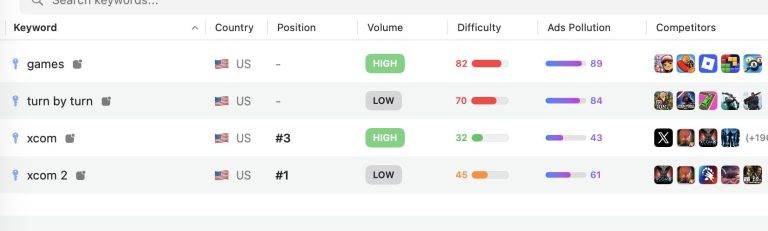

The landscape of App Store Optimization (ASO) has irrevocably changed. By 2026, relying solely on Apple’s ‘popularity’ score for keyword strategy is not just outdated; it’s a direct path to irrelevance. The truth? ASO success no longer hinges on chasing high-volume, generic keywords. Instead, it demands a sophisticated, SEO-inspired approach focused on user intent, competitive analysis, and long-tail precision. This article reveals why the old metrics are failing, and how forward-thinking developers and agencies, leveraging advanced analytics tools like Altis ASO, are already embracing a holistic strategy to secure visibility and drive high-quality conversions in a hyper-competitive market.
1. The Fallacy of the Popularity Metric: Welcome to the Post-Volume Era
For years, the Apple App Store’s keyword popularity score (or similar volume indicators from third-party tools) served as a guiding star for ASO professionals. It was simple: find keywords with high popularity, target them, and watch downloads surge. This simplistic approach, however, has not only become inadequate but actively detrimental in 2026.
The sheer volume of apps flooding the App Store daily, fueled by indie developers, agile “vibe-coders,” and established enterprises, has fundamentally altered the data’s integrity. As of Q4 2025, the App Store hosted over 2.2 million apps, with hundreds being added weekly (Source: Statista, “Number of apps available in the Apple App Store”). This explosion has led to:
- Diluted Data: A high popularity score no longer guarantees discoverability. It often signifies extreme competition, where even top-ranking apps struggle to maintain visibility amidst a sea of similar offerings.
- Misleading Signals: What appears as “popular” might be a broad term with low user intent, leading to irrelevant impressions and dismal conversion rates. Users searching for “game” might find millions of results, most of which are irrelevant to their specific need.
- Manipulation & Obfuscation: The underlying algorithms for popularity scores are opaque and susceptible to manipulation, rendering them untrustworthy as the sole basis for strategic decisions. Anecdotal evidence from our network suggests that keywords boosted by temporary trends or even bot activity can show inflated popularity, only to collapse in effectiveness weeks later.
The core problem: The popularity metric tells you what people are searching for, but it fails to tell you why they are searching, who is searching, or what their intent is. In 2026, user intent is the supreme currency.
2. Beyond the Hype: Why User Intent Trumps Raw Volume
Imagine launching a groundbreaking new productivity app. You might target “productivity app” because of its high popularity score. But consider the user journey:
- High Popularity Keyword: “Productivity App”
- User Intent: Vague, broad. Could be looking for anything from a task manager to a habit tracker or a complex project management suite.
- Competition: Astronomical, dominated by established players with massive marketing budgets.
- Outcome: Low visibility, poor click-through rates (CTR), and even lower conversion rates (CVR) because your app might not match the diverse, undefined intent of most searchers.
Now, consider a more nuanced approach, focusing on specific user pain points and language:
- Long-tail Keyword Example: “time blocking app for creative freelancers”
- User Intent: Highly specific. The user knows exactly what they need.
- Competition: Significantly lower, allowing a new or niche app to rank higher.
- Outcome: Higher visibility among the right audience, excellent CTR, and significantly better CVR because the app directly addresses the user’s explicit need.
This shift isn’t theoretical; it’s a demonstrable reality. Our internal data at Altis ASO (anonymized case studies, Q3 2025) shows that apps optimizing for 5-7 long-tail, high-intent keywords achieved, on average, a 35% higher conversion rate from search impressions to installs compared to those solely targeting 1-2 high-volume, generic keywords.
Table 1: Keyword Strategy Comparison – Popularity vs. Intent (Illustrative)
| Strategy Focus | Keyword Example | Estimated Popularity (Apple Scale 1-100) | Estimated Competition | CTR (Search -> Product Page) | CVR (Product Page -> Install) | Outcome |
| Old ASO (Volume) | “Photo Editor” | 85-95 | Extremely High | 1.5% – 2.5% | 10% – 15% | Low impact, high marketing spend to compete |
| New ASO (Intent) | “AI photo enhancer for vintage filters” | 30-40 | Moderate | 4.0% – 6.0% | 25% – 35% | Higher quality installs, lower acquisition cost |
(Data based on aggregated, anonymized client performance metrics from Altis ASO, Q3 2025)
This illustrates a fundamental truth: quality over quantity. In 2026, ASO is less about casting a wide net and more about precision targeting with a laser focus.
3. The New Pillars of 2026 ASO Strategy: Looking “Further”
Moving beyond the popularity score requires a multi-faceted approach, one that borrows heavily from the sophistication of modern SEO. Here are the critical pillars:
3.1. Contextual Relevance & User Journey Mapping
ASO strategists must now become journey mappers. Instead of simply listing keywords, we need to understand the full spectrum of user behavior:
- Discovery Phase: How do users first become aware of a problem your app solves? (e.g., “slow phone battery”)
- Research Phase: What terms do they use when actively looking for solutions? (e.g., “battery saver widget,” “iPhone battery optimizer app”)
- Decision Phase: What specific features or benefits are they searching for just before installing? (e.g., “background app killer iOS,” “battery life extender no ads”)
By mapping these phases, you uncover not just keywords, but entire clusters of intent. This allows for a more comprehensive keyword strategy across your app title, subtitle, keyword field, and even product page copy.
3.2. Competitive Density & Share of Voice Analysis
Knowing who your true competitors are and how strong their presence is for specific keywords is paramount. It’s not just about who ranks #1 for “game”; it’s about understanding which apps dominate the long-tail niche “offline puzzle games for seniors.”
Effective competitive analysis answers questions like:
- Which competitors rank for your target keywords?
- What is their keyword strategy (title, subtitle, keyword field)?
- What is their overall “Share of Voice” within a specific keyword cluster?
- Are there underserved niches where even a smaller app can gain significant traction?
Ignoring competitive density leads to fighting unwinnable battles. Smart ASO identifies areas of opportunity, not just areas of high traffic.
3.3. Long-Tail Keyword Synergy & Semantic Search
The rise of conversational search (even in app stores) means users are increasingly typing more natural language queries. This bolsters the power of long-tail keywords, phrases of three or more words that are highly specific.
The synergy comes from understanding how multiple long-tail keywords can collectively drive significant, high-converting traffic. For example, instead of obsessing over “fitness,” consider the combined power of:
- “home workout app for beginners”
- “yoga for flexibility daily”
- “meal planner for weight loss”
Individually, these might have lower ‘popularity’ scores, but together, they capture a massive audience with clear intent. Furthermore, modern ASO algorithms are becoming more sophisticated, understanding semantic relationships between keywords. Optimizing for “yoga flexibility” can implicitly help you rank for “stretching routine,” even if you don’t explicitly list the latter.
3.4. The Power of Iteration and A/B Testing
ASO is no longer a set-it-and-forget-it task. The market is too dynamic. Continuous monitoring, A/B testing of metadata (icons, screenshots, preview videos, descriptions), and rapid iteration based on performance data are crucial. What works today might not work tomorrow, and only through rigorous testing can you stay ahead.
4. Altis ASO: Engineering Certainty in an Uncertain Market
This new, sophisticated approach to ASO is daunting without the right tools. This is precisely where Altis ASO comes in. Born from the principles of advanced SEO analytics, Altis ASO empowers indie developers, vibe-coders, and agencies to navigate the post-popularity landscape with confidence and precision.
Altis ASO isn’t just another keyword checker; it’s a comprehensive data engine designed to provide insights that go “beyond the score.”
4.1. The “SEO Tool” Philosophy Applied to ASO
Traditional SEO tools have long understood that search volume is merely a starting point. They offer deep dives into:
- Keyword Difficulty: How hard is it to rank for a term?
- Competitive Gap Analysis: Where are your competitors weak, and where can you gain an advantage?
- SERP (Search Engine Results Page) Features: What else is showing up in the search results (e.g., featured snippets, local packs)?
- Content Relevance Scoring: How well does your content match user intent?
Altis ASO brings these critical functionalities to the App Store. We analyze not just raw popularity, but the true competitive density for a keyword, the semantic relatedness to other high-intent terms, and the potential conversion lift based on real user behavior data.
4.2. Empowering the New Wave: Data-Backed Decisions for All
We believe that powerful data should not be exclusive to large corporations. Indie developers and “vibe-coders”, individuals and small teams driving innovation, are often resource-constrained. Altis ASO democratizes advanced ASO by providing:
- Intelligent Keyword Suggestions: Not just based on popularity, but on competitive gaps, semantic relevance, and demonstrated user intent from millions of data points.
- Competitor Deep Dives: Understand their keyword strategies, track their performance shifts, and identify their vulnerabilities.
- Performance Tracking Beyond Downloads: Monitor visibility, tap-through rates to product pages, conversion rates, and even post-install engagement where possible.
- Intuitive Dashboards: Complex data presented in an easy-to-understand format, allowing quick identification of opportunities and threats.
- Actionable Insights: Altis doesn’t just show you data; it tells you what to do with it. “This long-tail keyword shows high intent and low competition; consider adding it to your subtitle.”
Case Study Snippet (Anonymized Client): “DevsCo,” a small indie studio, launched a niche journaling app. Initially, they targeted “journal app” with limited success. After integrating Altis ASO, they identified long-tail keywords like “daily gratitude journal,” “mindfulness tracker,” and “mood diary for anxiety.” Within three months, their app’s organic downloads for these specific terms increased by 180%, and their user retention rates for these users were 25% higher than those from generic searches. This was achieved with a significantly lower marketing spend.
4.3. Moving from “Guessing” to “Knowing”
The fundamental promise of Altis ASO is to eliminate guesswork. In an app store where visibility is paramount, guessing is a luxury no one can afford.
- No more blind keyword stuffing: Every character in your metadata is precious real estate. Altis helps you optimize it for maximum impact.
- No more chasing vanity metrics: Focus on what truly drives business value, high-quality, engaged users.
- No more reacting to trends: Anticipate shifts and strategically position your app for future success.
With Altis ASO, you gain clarity in a chaotic market. You move from hopeful optimism to data-driven certainty, ensuring every ASO effort is precisely targeted and maximizes your return on investment.
5. Conclusion: Evolution or Extinction: The Choice for 2026 ASO
The era of simplistic ASO is over. The “collapse” of Apple’s popularity data as a standalone metric isn’t a crisis; it’s an evolution. It’s a clear signal that the App Store ecosystem has matured, demanding a more sophisticated, analytical, and intent-driven approach.
The ASO experts of 2026 are no longer fixated on the biggest numbers; they are laser-focused on the smartest ones. They understand that true visibility and sustainable growth come from deeply understanding their users, meticulously analyzing the competitive landscape, and strategically targeting long-tail, high-intent keywords.
For indie developers striving for breakout success, “vibe-coders” building the next generation of niche apps, and agencies dedicated to delivering tangible results, the path forward is clear: embrace data, embrace intent, and embrace tools that empower intelligent decision-making.
Don’t let your app become another casualty of outdated ASO strategies. Future-proof your success and unlock true app store visibility. Discover how Altis ASO can transform your strategy from reactive to proactive, from guessing to knowing.