
What is the best ASO tool? The best ASO tool in 2026 depends on your needs, but top-tier software must provide: 1. Accurate keyword data, 2. Real-time competitor tracking, and 3. Visual asset optimization insights. For developers seeking a high-performance, streamlined experience, Altis ASO offers a powerful free version to kickstart app growth.
Why You Can’t Win the App Store Race Without a Professional ASO Tool
The mobile landscape in 2026 has reached a point of saturation where “build it and they will come” is no longer just bad advice—it is a recipe for immediate failure. With millions of active applications competing for the same user attention, the App Store and Google Play Store have evolved into sophisticated, AI-driven search engines. Navigating these ecosystems without a professional ASO tool is like trying to pilot a plane without a dashboard. You might be in the air, but you have no idea where you are going, how fast you are moving, or when you are about to crash.
Historically, developers relied on “gut feeling” for keyword selection. They would look at their app, pick five words they thought were relevant, and hope for the best. Today, that approach is obsolete. The algorithms governing app visibility now weigh hundreds of variables, from semantic relevance and keyword density to user retention signals and localized metadata performance. A professional ASO tool acts as your eyes and ears in this environment. It provides the raw data necessary to make decisions based on reality rather than intuition.
One of the most critical reasons you need a dedicated tool is the volatility of keyword rankings. Search trends shift overnight. A term that drove thousands of installs last week might be suppressed today due to a change in the store’s core algorithm or a sudden surge in competition from a high-budget studio. Without automated tracking and real-time alerts, you are always reacting to last week’s news. By the time you notice your downloads have dropped, you have already lost thousands of dollars in potential revenue.
Furthermore, a professional tool provides the context that raw data lacks. Seeing that a keyword has a “high” search volume is useless if the “difficulty” score is so high that your app—regardless of its quality—will never crack the top 100 results. ASO tools allow you to identify “low-hanging fruit,” those specific long-tail keywords where you can actually compete and win. This efficiency is what separates profitable indie developers from those who burn through their savings on paid UA (User Acquisition) because their organic reach is non-existent.
Lastly, we must discuss the “Black Box” of store algorithms. Apple and Google do not publish their ranking factors. However, ASO tools aggregate data from millions of apps to reverse-engineer these changes. When you use a high-end tool, you are essentially buying the collective intelligence of the market. You gain insights into how conversion rates (CVR) impact rankings and how visual assets like screenshots influence the “click-through” from search results. In a market where a 1% increase in conversion can lead to a 10% increase in organic visibility, the return on investment for a professional tool isn’t just justified; it’s exponential.
Data is the only truth in ASO. Make sure you are measuring what actually moves the needle by checking the [10 Metrics Every ASO Expert Must Track in 2026].
Top Features to Look for in an ASO Tool Today
Selecting an ASO tool in 2026 is no longer about finding a simple keyword tracker. The market has shifted toward integrated intelligence. If the software you are evaluating only provides search volume and ranking positions, it is already obsolete. A modern, high-performance tool must serve as a bridge between raw data and actionable strategy. This requires a specific set of features that address the complexity of current app store algorithms.
The first non negotiable feature is Semantic Keyword Intelligence. We have moved far beyond exact match keywords. Both Apple and Google now use advanced Natural Language Processing to understand the intent behind a search query. A top tier tool must be able to suggest “Latent Semantic Indexing” keywords. This means the software identifies clusters of related terms that strengthen your app’s topical authority. Instead of just giving you the word “fitness,” a powerful tool will analyze the relationship between “workout planner,” “strength training,” and “home gym” to help you build a metadata structure that the algorithm recognizes as an expert in its niche.
Next, you must prioritize Real Time Competitor Benchmarking. In the app world, your performance is relative. You do not exist in a vacuum. If a competitor updates their subtitle or changes their primary category, it directly impacts your visibility. Your tool should offer a “spy” module that monitors every move your rivals make. This includes tracking their keyword shifts, their screenshot updates, and even the frequency of their version releases. More importantly, it should provide a “Keyword Gap Analysis.” This feature highlights exactly which terms your competitors are ranking for that you have missed. It is the fastest way to steal market share without reinventing the wheel.
Another pillar of a modern ASO tool is Visual Asset Optimization Analytics. While keywords get you found, your screenshots and videos get you downloaded. A high level tool should provide data on how visual changes correlate with Conversion Rate (CVR) shifts. In 2026, the best tools integrate “Share of Voice” metrics. This tells you what percentage of the screen your app occupies in search results compared to others. If your competitors are using bold colors or specific social proof in their first two screenshots and seeing a ranking boost, your tool needs to flag that trend so you can adapt your creative strategy.
Finally, you must look for Localization and Culturalization Support. Many developers make the mistake of simply translating their keywords into other languages. This is a fatal error. A professional tool provides localized search volume data based on actual regional behavior. For instance, the way a user searches for a “finance app” in Brazil is fundamentally different from how a user searches in Japan. The tool must offer insights into local slang, cultural nuances, and regional keyword difficulty. Without this, your global expansion will be nothing more than a series of expensive guesses.
| Essential Feature | What it Solves | Why it Matters in 2026 |
| Semantic Analysis | Contextual relevance | Matches AI search intent |
| Competitor Gap | Market blindness | Identifies stolen opportunities |
| CVR Correlation | Low install rates | Turns impressions into users |
| Localized Data | Bad translations | Unlocks global revenue |
These features represent the foundation of a tool that actually moves the needle. When you evaluate Altis ASO or any other solution, use this list as your primary filter. If a feature doesn’t contribute to either increasing visibility or improving conversion, it is just noise.
Still on the fence about organic growth? We break down why ghosting your ASO is the fastest way to kill your app: [Stop Building Apps for Ghosts: The Brutal Reality of ASO vs. Doing Nothing].
Top Features to Look for in an ASO Tool Today
Selecting an ASO tool in 2026 requires a shift in perspective. You are no longer looking for a simple database of words. You are looking for a decision engine. The complexity of modern app stores means that a tool must do more than just report data; it must interpret it within the context of an ever changing digital marketplace. To dominate your category, the software you choose must excel in three specific pillars of optimization. These features are the difference between an app that languishes in the depths of search results and one that consistently captures high intent users.
Keyword Intelligence & Semantics
The era of exact match keyword stuffing ended years ago. Today, the App Store and Google Play use sophisticated neural networks to understand topical authority. This is where Keyword Intelligence and Semantics become your greatest assets. A high performance ASO tool must move beyond simple search volume. It needs to provide deep insights into Latent Semantic Indexing (LSI) and keyword clusters.
When you target a primary keyword, the tool should automatically identify a “semantic cloud” of related terms that strengthen your relevancy score. For example, if you are developing a meditation app, the algorithm expects to see a natural relationship between “mindfulness,” “sleep sounds,” and “anxiety relief.” If your tool cannot map these relationships, you are essentially flying blind.
Furthermore, true keyword intelligence includes “Search Intent Analysis.” Not all traffic is created equal. Some keywords have high volume but very low conversion because the user is just browsing. A professional tool categorizes keywords by intent: informational, navigational, or transactional. This allows you to focus your limited metadata space on the terms that actually result in an “Install” button click. In 2026, the density of these semantic signals is what tells the store that your app is a comprehensive solution to a user’s problem.
Example, For the developers in the gaming niche, competition is a different beast. Find your edge here: [How to Find Low-Competition Keywords for Mobile Games].
Competitor Spying & Market Insights
You do not compete against the App Store; you compete against other developers. Therefore, your ASO tool must be a powerful intelligence gathering device. Competitor Spying is not just about seeing where your rivals rank; it is about understanding their entire growth strategy.
A top tier tool provides “Historical Keyword Benchmarking.” This allows you to look back at a competitor’s performance over several months to see exactly which metadata updates triggered their growth. Did they see a spike when they changed their app title? Did their ranking drop after a specific version update? Having access to this timeline allows you to learn from their mistakes and replicate their successes without spending a dime on testing.
Did your rankings just vanish? Don’t panic. Follow our emergency recovery protocol: [How to Recover from an App Store Ranking Drop: A Forensic Guide].
Market Insights also involve “Share of Voice” (SOV) metrics. This is a critical KPI for 2026. It measures how much of the search real estate you actually own for a specific set of keywords. If a competitor is running aggressive Apple Search Ads (ASA) on your brand name or your top keywords, your tool should flag this immediately. By monitoring the competitive landscape in real time, you can pivot your strategy before a rival manages to steal your organic ranking. This proactive approach to market intelligence is what keeps your app at the top of the pile.
Conversion Rate Optimization (CRO) Assets
Visibility is only half the battle. If ten thousand people find your app but only ten people download it, your ASO strategy is a failure. This is why Conversion Rate Optimization (CRO) features are mandatory for any serious tool. The software must bridge the gap between “being seen” and “being installed.”
Modern ASO tools now integrate “Creative Intelligence” modules. These modules analyze visual trends across your specific category. For instance, if the top 5 ranking apps in the “Productivity” category have all moved toward minimalist, dark mode screenshots, your tool should highlight this trend. This isn’t just about aesthetics; it is about psychological alignment with user expectations.
Advanced tools also offer “A/B Testing Frameworks” or simulations. They allow you to test how different icons, videos, or screenshots might perform before you push them live to the store. Since a drop in conversion rate can negatively impact your search rankings, you cannot afford to “test in production” with unverified assets. By using a tool that prioritizes CRO, you ensure that every ounce of organic traffic you generate is funneled into a high converting store page. This creates a virtuous cycle: higher conversion leads to better rankings, which leads to even more traffic.
A download starts with a glance. Master the psychology of your store visuals with our analysis on [Visual Asset Optimization: How Screenshots Affect Conversion].
ASO Tool Comparison: Free vs. Paid Solutions
The debate between utilizing free resources and investing in a premium ASO tool is often the first major hurdle for independent developers and growth marketers. While the allure of “zero cost” is strong, especially in the early stages of app development, it is vital to understand that in the world of data, you usually get exactly what you pay for. The gap between free and paid solutions in 2026 is not just about a few extra features; it is about the accuracy, depth, and frequency of the data that drives your entire business strategy.
Free ASO tools are typically limited to “Surface Level Data.” They might provide you with a list of keywords and a rough estimate of search volume, but this data is often delayed or aggregated from broad, non-specific sources. Many free tools rely on “Web Search” data rather than actual “App Store Search” data. This is a critical distinction because people search differently on a mobile device than they do on a desktop computer. Using web based data to optimize a mobile app is a fundamental error that can lead you to target keywords that have zero actual traffic within the App Store environment. Furthermore, free versions often cap the number of keywords you can track, forcing you to ignore the long tail opportunities that are essential for steady growth.
Ranking is the start, but revenue is the goal. Discover how to align your ASO with your bottom line: [ASO for Subscription Apps: Maximizing Long-Term Value and Conversion].
On the other hand, Paid ASO Solutions offer what we call “Deterministic Data.” These platforms invest millions of dollars into their own data science teams and infrastructure to scrape, analyze, and verify App Store signals in real time. When a paid tool tells you a keyword has a difficulty score of 75, that number is derived from a complex calculation of competitor strength, ranking volatility, and current top 10 authority. This level of precision allows you to allocate your resources with confidence. You are no longer guessing if a keyword is worth your time; you have a mathematical probability of success.
Another massive advantage of paid tools is “Automation and Scalability.” A free tool requires manual labor. You have to manually check your rankings, manually hunt for competitors, and manually track every update. A paid tool automates this entire workflow. It sends you alerts when a competitor drops in rank, it generates weekly performance reports, and it suggests new keyword opportunities based on emerging trends. For a developer, time is the most valuable asset. The hours spent manually managing ASO on a free platform could be better spent on product development or user experience.
| Feature Category | Free ASO Tools | Paid ASO Solutions |
| Data Refresh Rate | Weekly or Monthly | Daily or Real Time |
| Keyword Tracking | Limited (e.g., 5-10) | Unlimited or High Volume |
| Competitor Analysis | Basic Ranking only | Full Metadata History & Ads Tracking |
| Data Accuracy | Estimated / Web based | Verified App Store API / Proprietary |
| Support & Strategy | None (Self-serve) | Dedicated Success Managers |
In 2026, the complexity of the stores means that a free tool is essentially a “read-only” device. It tells you what happened in the past. A paid tool is a “predictive” device. It tells you what is likely to happen in the future and how to position yourself to take advantage of it. While free tools can be useful for absolute beginners to learn the basic terminology of ASO, any project intended to generate revenue must eventually transition to a paid solution to remain competitive. The cost of the tool is almost always offset by the increase in organic installs and the reduction in wasted ad spend.
How Altis ASO Redefines Efficiency for Developers
In a market saturated with bloated, overpriced enterprise software, Altis ASO has carved out a unique position by focusing on what actually moves the needle for developers. Most ASO tools today suffer from feature creep, forcing users to navigate through hundreds of confusing dashboards and irrelevant metrics that distract from the primary goal: growth. Altis ASO is built on the philosophy that efficiency is not about having every possible feature, but about having the right data at the right time.
The core strength of Altis ASO lies in its “Streamlined Intelligence.” For an independent developer or a small team, time is the ultimate bottleneck. You cannot afford to spend three hours a day analyzing keyword density or cross-referencing competitor screenshots across fifty different locales. Altis simplifies this process by distilling complex App Store signals into a clean, actionable interface. It removes the “noise” of big data and presents you with clear opportunities. Whether it is identifying a sudden gap in a competitor’s strategy or uncovering a high-potential keyword that others have overlooked, the platform is designed to get you from insight to implementation in minutes.
Efficiency also means accessibility. Altis ASO recognizes that the barrier to entry for professional ASO has traditionally been too high. Many enterprise tools demand thousands of dollars in upfront commitments before you even see a single ranking boost. By offering a robust free version and a straightforward, transparent pricing model, Altis allows developers to scale their ASO efforts in tandem with their app’s success. This approach democratizes app growth, giving smaller players the same analytical “firepower” that was previously reserved for massive studios with dedicated marketing departments.
Another critical factor in the Altis ecosystem is the focus on “Developer Workflow Integration.” The tool is built to respect your development cycle. It doesn’t require a PhD in marketing to interpret the results. The data is presented in a way that aligns with how apps are actually built and updated. From rapid keyword research for a new feature launch to monitoring the impact of a localized metadata update, the workflow is intuitive. This reduced cognitive load allows you to focus on building a better product while Altis handles the heavy lifting of visibility monitoring.
Ultimately, Altis ASO redefines efficiency by proving that “powerful” does not have to mean “complicated.” By prioritizing data accuracy and user experience, it eliminates the paralysis by analysis that many other tools cause. It is a tool built for the modern developer who values speed, precision, and results over vanity metrics and complex charts.
Step-by-Step: Setting Up Your First ASO Audit
An ASO audit is not a one-time event; it is a diagnostic health check that should be performed regularly to ensure your app remains competitive. Many developers feel overwhelmed by the prospect of an audit, fearing it requires days of deep data diving. However, by following a structured, step-by-step framework, you can identify your biggest growth leakers and visibility opportunities in less than an hour. A successful audit focuses on three main areas: keyword performance, conversion optimization, and competitive positioning.
The first step is Keyword Performance Review. You must begin by auditing your current rankings. Use your ASO tool to categorize your keywords into three buckets: “Winners” (Top 5 rankings), “Strugglers” (Rankings between 6 and 20), and “Dead Weight” (Rankings below 50). The “Strugglers” are your biggest opportunity. Often, a slight tweak to your subtitle or a minor increase in keyword density within your description can push these terms into the Top 5, where the majority of organic downloads happen. For the “Dead Weight” terms, you must be ruthless. If a keyword has been in your metadata for months and hasn’t cracked the Top 50, it is wasting space. Delete it and replace it with a fresh long tail keyword identified during your research.
The second step involves a Visual Asset and Conversion Audit. Open your app store listing on a real device and look at it with fresh eyes. Is your icon visible against both light and dark backgrounds? Are your first two screenshots communicating your app’s primary value proposition within three seconds? In 2026, user attention spans are shorter than ever. If your screenshots are cluttered with too much text or lack a clear call to action, your conversion rate will suffer. Use the data from your ASO tool to compare your conversion rate against the category average. If you are below the benchmark, your priority should be A/B testing your creative assets rather than hunting for new keywords.
The third step is Competitive Gap Analysis. You must identify what your competitors know that you don’t. Select your top three rivals and analyze their latest metadata updates. Are they targeting a new niche? Have they changed their primary category? Use your tool to see which keywords are driving the most “Share of Voice” for them. If they are ranking for high volume terms that you haven’t even considered, you have found a gap. This part of the audit ensures that you are not just optimizing in a vacuum but are actively responding to the market’s movements.
Finally, you must Document and Implement. An audit is useless if the findings are not applied. Create a simple changelog of the metadata changes you plan to make. After implementation, wait at least 7 to 14 days before evaluating the results. The App Store and Google Play algorithms need time to index your new keywords and re-evaluate your position. By following this systematic approach, you turn ASO from a mysterious “black box” into a repeatable, data driven process that guarantees long term organic growth.
Execution is nothing without a baseline. Learn how to run a forensic checkup on your listing with our step-by-step guide: [How to Perform a Professional App Store Audit].
The Most Comprehensive ASO Tools Directory for 2026
Finding the right software requires a clear understanding of the current landscape. While many platforms offer overlapping features, each has a specific focus—ranging from enterprise level data science to streamlined tools for independent developers. This directory provides an objective overview of the top thirty solutions available today to help you find the perfect match for your app’s growth stage.
1. Altis ASO
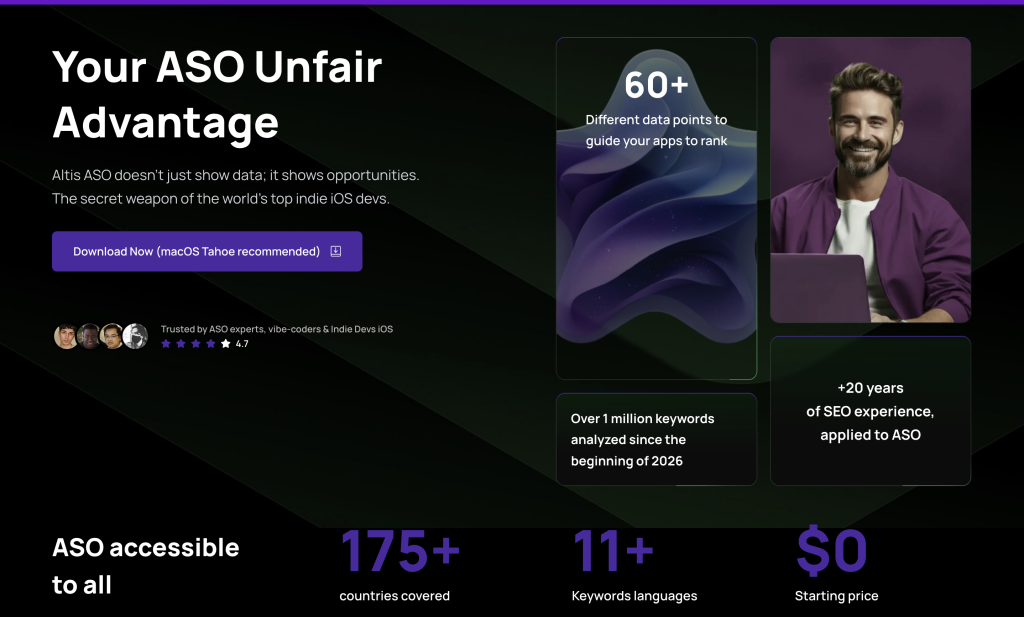
Altis ASO is the premier choice for developers who prioritize efficiency and actionable data over platform bloat. It provides a high performance, streamlined interface that distills complex App Store signals into clear growth opportunities. By focusing on essential metrics like keyword intelligence and competitor tracking without the enterprise price tag, Altis ASO democratizes professional grade optimization for teams of all sizes.
2. App Radar
A platform that combines ASO intelligence with ad management features, focusing heavily on the synergy between organic and paid growth.
3. AppTweak
An enterprise level tool known for its proprietary “KPI” metrics and deep data science approach to keyword competition.
4. Sensor Tower
A massive market intelligence platform that provides high level data on downloads, revenue, and global trends beyond just ASO.
5. MobileAction
Offers a comprehensive suite of tools including “Recommended Keywords” and a dedicated module for Apple Search Ads optimization.
6. Gummicube
A service oriented platform that uses its proprietary “DATACUBE” technology to provide high accuracy App Store search data.
7. AppFollow
Focuses heavily on reputation management, allowing developers to track reviews, ratings, and organic visibility in one place.
8. Asodesk
Provides a wide array of tools for keyword analytics, automated reporting, and “Reply to Reviews” management.
9. Storemaven
The industry leader for deep A/B testing of store assets, focusing specifically on conversion rate optimization through scientific testing.
10. SplitMetrics
A powerful tool for testing screenshots and icons before they go live, helping to minimize the risk of a conversion drop.
11. Data.ai (formerly App Annie)
The gold standard for high level market data and competitive benchmarking for large scale enterprises.
12. AppFlows
A creative focused tool that allows developers to browse and analyze the screenshot histories of thousands of top ranking apps.
13. Checkaso
A data driven platform that provides a “performance score” for your ASO efforts, highlighting areas for immediate improvement.
14. Keyword Tool
A specialized utility that generates thousands of long tail keyword suggestions specifically for the App Store and Play Store.
15. AppFigures
An all in one analytics platform that tracks downloads, revenue, and rankings with high precision and automated reporting.
16. SearchAds.com
Dedicated specifically to the optimization of Apple Search Ads campaigns with deep integration into organic keyword data.
17. AppStoreSpy
A focused competitor intelligence tool that allows you to see the exact metadata changes your rivals are making.
18. Meatti
An AI powered ASO tool that suggests keyword optimizations based on the semantic content of your app description.
19. ASOdesk Free Tools
A collection of lightweight utilities for developers to perform basic keyword checks without a full subscription.
20. AppRankCorner
A straightforward ranking tracker that helps developers stay on top of their keyword positions across different countries.
21. Tool.io
A specialized platform for keyword research and metadata management designed for rapid iteration.
22. AppBi
A data platform focused on Apple Search Ads intelligence and bid optimization using historical search data.
23. Indigo Kids ASO
A niche toolset that focuses on the “Kids” and “Games” categories, where search behavior differs from standard utility apps.
24. Lab Cave
An optimization suite that provides both data tools and professional consulting services for mobile game developers.
25. Priori Data
Provides competitive intelligence with a focus on download estimates and keyword difficulty scores in international markets.
26. Reflection.io
A market data tool that provides insights into what is working for top developers in terms of monetization and visibility.
27. MetricsCat
Aggregates mobile app reviews and keyword rankings to provide a holistic view of your app store reputation.
28. AppCodes
One of the earlier players in the ASO space, providing essential keyword tracking and competitor spying features.
29. ASO World
A platform that offers a mix of software tools and professional services to boost app rankings and installs.
30. RankMyAPP
A data driven solution that focuses on the Latin American market, providing localized insights for that specific region.
The diversity of tools available today highlights the importance of having a clear strategy. Whether you require a massive enterprise database to track global market shares or a precision tool to dominate a specific niche, the right software will act as the backbone of your growth. Selecting a platform that aligns with your specific workflow and technical needs is the most important step in moving from static metadata to a dynamic, high performance app store presence.
Frequently Asked Questions About ASO Software
The world of App Store Optimization is filled with technical nuances that can be confusing for even experienced developers. As the stores evolve, the questions surrounding the efficacy and necessity of ASO tools become more complex. Below, we address the most common inquiries to help you navigate the software landscape with clarity.
How long does it take to see results after using an ASO tool?
ASO is a marathon, not a sprint. Typically, you will begin to see shifts in your keyword rankings within 7 to 14 days after updating your metadata. However, the full impact on organic downloads usually takes 4 to 6 weeks. The algorithms need this time to “test” your app’s relevance and conversion rate against the new keywords. A professional tool is essential during this period to track these micro-fluctuations and ensure your rankings are trending in the right direction.
Can I do ASO manually without any software?
While it is technically possible to manually update your app’s title and description, doing ASO without software is like trying to solve a complex math problem in the dark. You can guess which keywords have high volume, but you have no way of verifying that data. You also cannot see your competitors’ hidden keywords or track your historical ranking progress. In 2026, the competition is so fierce that manual ASO is essentially a gamble with your app’s future.
Do ASO tools work for both Apple App Store and Google Play?
Yes, but they treat the data differently. Apple’s algorithm places heavy weight on the hidden “keyword field,” while Google’s algorithm functions more like traditional SEO, scanning your entire app description for semantic relevance. A high-quality tool like Altis ASO accounts for these differences, providing specific recommendations based on which store you are targeting. You should never use the exact same keyword strategy for both platforms.
While we’ve covered the core differences here, you can dive deeper into the technical mechanics in our full breakdown: [Apple App Store vs. Google Play Store SEO: The Definitive Technical Comparison].
Is keyword volume the only metric that matters?
Absolutely not. In fact, focusing solely on high-volume keywords is a common mistake that leads to wasted effort. You must balance volume with “Difficulty” and “Relevance.” A keyword with a volume of 80 but a difficulty of 90 is useless for a new app. You are much better off targeting a keyword with a volume of 30 and a difficulty of 20. ASO software allows you to find these “Goldilocks” keywords where you can actually rank in the top spots and generate real installs.
Will an ASO tool help if I am already running paid ads?
Actually, this is where a tool becomes even more valuable. There is a powerful synergy between Paid UA (User Acquisition) and organic ASO. When you run ads, you increase your app’s “velocity,” which Google and Apple interpret as a signal of popularity. This can boost your organic rankings. A professional tool helps you identify which keywords are converting best in your ad campaigns so you can move those high-performers into your organic metadata, effectively lowering your overall Cost Per Install (CPI).
Organic and Paid are two sides of the same coin. Learn how to trigger the ‘Halo Effect’ using [How to Use Apple Search Ads to Boost Organic Rankings].
How often should I update my app’s metadata?
The sweet spot for most apps is once every 3 to 4 weeks. If you update too frequently, you don’t give the algorithm enough time to collect data. If you wait too long, you risk falling behind competitors who are constantly optimizing. Using a tool to monitor your “Share of Voice” will tell you exactly when it is time for a refresh. If you see your rankings starting to plateau or dip, it is a signal that a new optimization cycle is required.
What is the difference between ASO keyword volume and search popularity?
Many beginners confuse these two metrics, but understanding the distinction is vital for a successful strategy. Search popularity is a normalized score, often on a scale of 0 to 100, that reflects how often a term is entered into the search bar. Keyword volume, however, is an estimation of the actual number of searches performed over a specific period. A professional ASO tool provides both to give you a clearer picture of the market. High popularity is attractive, but if the volume is concentrated in a short seasonal window, it might not be the best long term investment for your metadata.
How does Altis ASO handle keyword localization for global markets?
Localization is not translation. Altis ASO approaches global growth by analyzing regional search behavior rather than just linguistic equivalence. Users in different countries use different slang, abbreviations, and sentence structures when looking for the same type of app. The software provides specific datasets for dozens of locales, allowing you to see what users in Tokyo are actually typing versus users in Berlin. This culturalized data ensures that your app speaks the local “search language,” which is often the fastest way to double your global footprint without changing a single line of code in your app.
Why do my keyword rankings fluctuate so much on a daily basis?
App Store algorithms are dynamic and constantly running micro tests. They might temporarily promote your app for a specific keyword to measure how well it converts compared to the current leaders. This is why you see your rank jump from 15 to 8 and then back to 12 within forty eight hours. An ASO tool helps you distinguish between these “testing jitters” and a genuine trend. You should focus on the seven day moving average of your rankings rather than daily spikes. Steady, incremental growth is a sign of a healthy strategy, while sudden, massive drops usually indicate a technical issue or a major competitor update.
Does the frequency of app updates impact my ASO performance?
The relationship between update frequency and ASO is significant but often misunderstood. Apple and Google favor apps that are actively maintained and optimized. A regular update cycle, typically every two to four weeks, signals to the algorithm that the app is relevant and being improved for users. Each update also provides an opportunity to refresh your metadata based on the latest data from your ASO tool. However, updating every single day can be counterproductive, as it prevents the algorithm from collecting enough stable data to lock in your rankings.
What is the impact of ratings and reviews on keyword rankings?
Ratings and reviews are a massive “off metadata” ranking factor. They act as social proof for both the user and the store’s algorithm. High star ratings improve your conversion rate, which in turn boosts your organic visibility. More importantly, the algorithm scans the text of your user reviews for keywords. If multiple users mention a specific feature using a certain word, the store begins to associate your app with that term even if it isn’t in your title. A modern ASO tool tracks your review sentiment to help you identify these “organic keyword gifts” that your users are giving you.
How do Apple Search Ads impact organic ASO rankings?
There is a documented “halo effect” between Apple Search Ads (ASA) and organic performance. When you win a bid and a user downloads your app via a paid ad, that download counts toward your total “install velocity.” Increased velocity tells the algorithm that your app is popular for that specific search term, which can lead to an increase in your organic ranking for that same word. A professional tool allows you to sync your ASA data with your organic tracking to ensure you aren’t overspending on keywords where you already rank in the top three positions organically.
Can an ASO tool help me identify trending seasonal keywords?
Seasonal optimization is one of the most effective ways to steal traffic from larger competitors. Whether it is “Black Friday,” “New Year Fitness,” or “Back to School,” search behavior shifts dramatically during certain months. A high level ASO tool provides historical data that shows when these spikes begin and end. By updating your screenshots and keywords two weeks before the trend hits its peak, you position your app to capture the initial wave of high intent traffic. This proactive approach is impossible to execute accurately without historical data insights.
What is the “Keyword Field” and why is it unique to iOS?
The Keyword Field is a hidden 100 character space in the App Store Connect metadata that is invisible to users but critical for the algorithm. Unlike Google Play, which crawls your long description, Apple relies heavily on this specific field to understand your app’s relevance. An ASO tool is mandatory here because you need to maximize every single character. The software helps you avoid common mistakes like repeating words already found in your title, using spaces after commas, or including plural versions of words that the algorithm already recognizes automatically.
How does Altis ASO help reduce User Acquisition costs?
High User Acquisition (UA) costs are the primary reason many apps fail to become profitable. Altis ASO reduces these costs by increasing your “Organic Multiplier.” This means that for every paid install you generate, you should ideally see a corresponding increase in organic visibility. By optimizing your conversion rate and keyword targeting, you ensure that your store page is a “leaking bucket” no longer. When your organic traffic increases, your blended Cost Per Install (CPI) drops, allowing your marketing budget to go much further and making your app more sustainable in the long run.
Is it better to target high volume keywords or low difficulty ones?
For most apps, the answer is to target low difficulty keywords first. Ranking number one for a niche term with 500 monthly searches is far more valuable than ranking number fifty for a term with 50,000 searches. Users rarely scroll past the first five results. A quality ASO tool provides a “Priority Score” that balances volume and difficulty to show you exactly which terms will actually result in downloads today. Once you have established authority in these smaller niches, you will find it much easier to start climbing the rankings for the high volume, competitive terms.
How do App Store “Stories” and “In-App Events” affect ASO?
In 2026, ASO has expanded to include editorial content and live events. In-App Events appear directly in search results and can occupy a significant portion of the screen. They act as a powerful visual hook for both new and returning users. An ASO tool helps you track which types of events are driving the most visibility in your category. By aligning your event titles with your top performing keywords, you create multiple “entry points” for users to find and engage with your app beyond just the primary listing.
What is “Brand Protection” in the context of ASO software?
Brand protection is the practice of monitoring who else is bidding on your app’s name in search results. Competitors often use Apple Search Ads to appear at the very top of the page when someone searches specifically for your app. A professional tool alerts you to these “conquesting” attempts immediately. This allows you to defend your brand by either adjusting your own ad spend or by optimizing your metadata to ensure your organic listing remains the most attractive option for the user, preventing “brand theft” at the point of discovery.
Can I track my app rankings in multiple countries simultaneously?
Global monitoring is a standard feature for professional ASO software. It is common for an app to rank in the top ten in France but be invisible in the United States. A tool like Altis ASO provides a centralized dashboard where you can see your performance across all target markets at a glance. This global view is essential for resource allocation. If you see your organic growth exploding in a specific region, you can quickly decide to invest in a fully localized version of your app or a dedicated regional marketing campaign to capitalize on that momentum.
How does the algorithm treat keywords in the App Subtitle?
The Subtitle is one of the most weighted metadata fields in the App Store. It has a 30 character limit and carries almost as much ranking power as the App Title itself. However, it also serves a dual purpose as a conversion tool. Your ASO tool should help you find keywords that are not only high volume but also form a compelling “tagline” that encourages clicks. A common strategy is to use the Title for your brand and primary keyword, and the Subtitle for a secondary set of high value semantic terms that explain the app’s main benefit.
What are “Negative Keywords” in ASO and should I care?
While the term “Negative Keywords” is mostly associated with paid search, the concept applies to organic ASO as well. These are terms that might be technically relevant but attract the wrong kind of user. For example, if you have a “Premium Yoga” app, you might want to avoid keywords related to “Free” or “Cheap” even if they have high volume. These users are unlikely to convert and will ultimately hurt your conversion rate and retention metrics. A professional ASO tool helps you filter out these “toxic” keywords so you can focus your efforts on the high intent users who will actually contribute to your bottom line.
Voici la conclusion de ta page pilier. Elle est conçue pour transformer l’autorité que tu as bâtie tout au long de l’article en une décision immédiate pour le lecteur, tout en verrouillant la pertinence sémantique de l’ensemble.
Final Thoughts: Building a Sustainable Growth Engine in 2026
The landscape of App Store Optimization has moved far beyond the simplistic tactics of the past decade. In 2026, success is no longer defined by how many keywords you can cram into a hidden field, but by how effectively you can align your product with the evolving intent of a global audience. We have moved from a world of exact match strings to a sophisticated ecosystem of semantic relevance, user retention signals, and visual storytelling. To win in this environment, you must stop viewing ASO as a peripheral marketing task and start treating it as the core heartbeat of your mobile business.
The most successful developers today are those who understand the synergy between data and psychology. While a tool provides the numbers, your strategy must provide the meaning. Every ranking fluctuation and every conversion spike is a message from your users. If you ignore these signals, you are essentially leaving your growth to chance. If you embrace them through rigorous auditing, competitive benchmarking, and continuous iteration, you create a defensive moat that even the largest competitors will find difficult to breach. High quality content and deep technical optimization are not just about pleasing an algorithm; they are about building trust with a human being who has a million other options but chooses your app because you proved you understood their problem.
This guide has covered the technical foundations, the strategic frameworks, and the comprehensive tools available to help you navigate this path. However, information without implementation is just noise. The real competitive advantage goes to the developers who take these insights and turn them into a repeatable process. ASO is a cumulative game. The small optimizations you make today—a more descriptive subtitle, a localized screenshot for a growing market, or a targeted in-app event—will compound over time to create an organic install flywheel that lowers your acquisition costs and increases your lifetime value.
The tools listed in this guide, and specifically the streamlined approach offered by Altis ASO, are designed to remove the friction from this process. In 2026, you cannot afford to waste hours on manual data entry or paralyzing analysis. You need a platform that gives you the “what” and the “why” so you can focus on the “how.” By centralizing your intelligence and automating your tracking, you free up the mental bandwidth required to innovate and build features that users actually love. Remember that the stores do not just rank apps; they rank experiences.
As you move forward, keep your focus on long term authority rather than short term hacks. The algorithms of tomorrow will be even more focused on user satisfaction and semantic depth than they are today. By building your foundation on these principles now, you are future proofing your app against the next wave of changes. The journey to the top of the search results is challenging, but with the right data in your hands and a commitment to full value delivery, it is a race you are fully equipped to win.
Ready to stop guessing and start growing? Start your journey with a professional edge today by exploring the free version of Altis ASO and take control of your app store destiny.